German Shepherds for Sale   |  German Shepherd Puppies for Sale
for 


COURAGE - CHARACTER - COMMITMENT
Germany’s Finest in America
We are located North of Dallas, Texas
214-287-8080
HausMerkel@Yahoo.com

Last updated - Friday, January 29, 2010 09:34:50 PM -0500

HAUS MERKEL BLOG

Home
About Us

German Shepherd Puppies for Sale •

Older Puppies for Sale •


Our German Shepherd Males

Our German Shepherd Females •
Males for Sale

Females for Sale

Our German Shepherd Stud Dogs
Breeding Requirements for Stud

German Shepherd Rescues •
Memorials
Articles
OFA  •
Classifieds
 
More Links:
 
HEALTH ARTICLES:
MORE ARTICLES:
Other Links
Links
Contact
Add your Link
 
Members of           
GSDCA

WDA

Schutzhund USA

SV-Germany
 

The Importance of Puppy Socialization
From the very start, a puppy learns important lessons through his experience of the world around him. Even in the first few weeks as he snuggles with his dam, wrestles with his littermates, and is handled by his breeder each day, the personality traits and social skills that he will have all his life are beginning to form.

As the weeks go by, exposure to a variety of experiences is crucial to his becoming a well-rounded adult. Studies have shown that a puppy's experiences in the first three months of life strongly influence what kind of companion he will grow to be and how he will react to the world. Will he shy away from children? Will he be afraid of people in hats? Will he be aggressive toward other dogs? Or will he be easygoing and adaptable in a variety of situations?
READ MORE...

"The man who rears a dog must complete what the breeder began..." Max v. Stephanitz; Father of the German Shepherd Dog

        Dealing Dogs Documentary
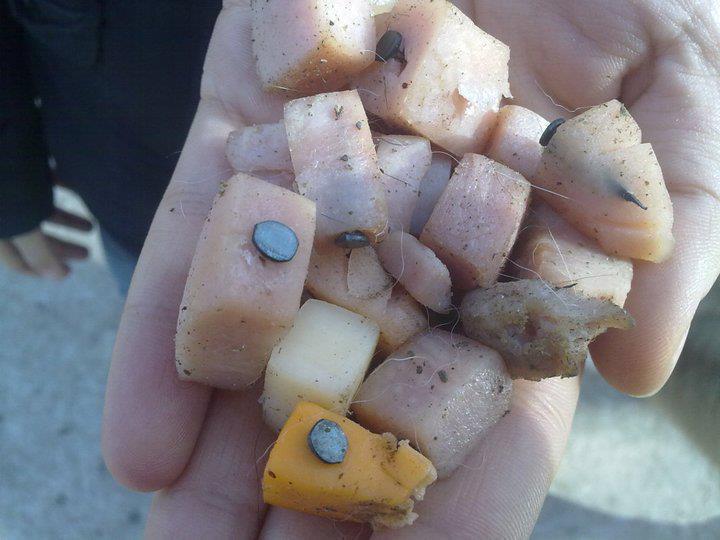
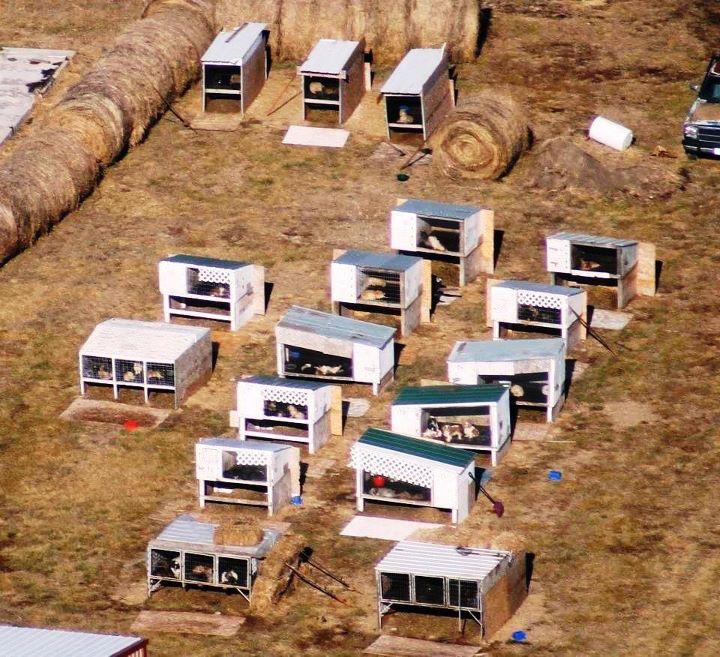
An animal rights outfit, Last Chance for Animals, outraged that 42,000 dogs are sold to vet schools and research labs by vile kennel keepers, sets out on one of the most notorious: Martin Creek Kennel in Arkansas. It sent in investigator "Pete" with a hidden camera for six months. He worked for the owners and collected his sickening images
and commentated on the atrocities as he went.  Many of the dogs that ended up at this kennel had been stolen from their
backyards and sold.


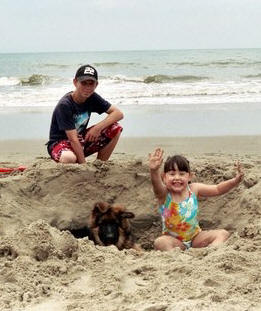
"Fun at the Beach"

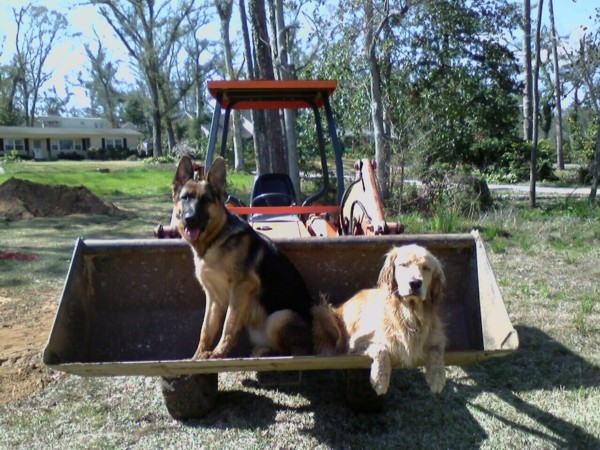
"Fun at Work"

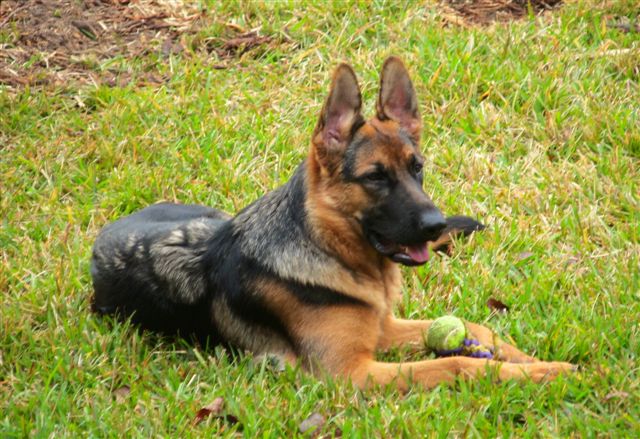
"Fun just hanging out"


How to Protect your Pet from Heat Stroke


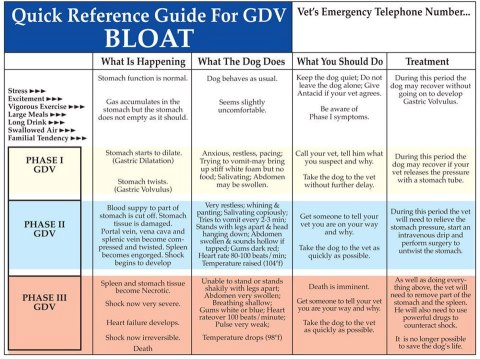
BLOAT


This is a real combination of symptoms that spells out EMERGENCY. These are the classic symptoms of a condition referred to as "bloat" - a dog that is pacing, restless and has unproductive attempts to vomit.

This is a common problem in large breed deep-chested dogs but can also occur in smaller dogs.

Basically what happens is this - the stomach twists causing the blood supply to the stomach to be compromised then leads to tissue death. As tissues are damaged, toxins are released and a sequence of events occurs that if left untreated, leads to death.

If you ever notice these symptoms in your dog, call your local veterinarian or emergency clinic as soon as possible.

This is a condition that is fairly common and often occurs in the evening or nighttime hours. It is also a very expensive condition to treat.  READ MORE...

 
            GOT FLEAS?
Place a white baking dish half full of water with a couple drops of Lemon Joy dishwashing liquid in the center of the room with a small lamp next to it.  Turn off all other lights and go to bed.  When you wake up in the morning all the fleas will be in the baking dish! For a bad infestation treat each room twice.
 

Dealing with Excessive Barking

The first step to stopping barking is to understand why it is happening. Dogs bark for all kinds of reasons, including anxiety, boredom and/or loneliness. Sometimes they bark just because it feels good.  Luckily, most dogs will respond to one or other intervention to curtail their barking. Whether you simply bring an outdoor dog inside or take the time to apply behavior-modification techniques, you can cause a dog to be less of a nuisance and to be more socially acceptable.


Removing Skunk Odor

No need for the tomato juice. Use a mixture of 10 parts hydrogen peroxide to 1 part baking soda. Add a dash of degreasing dishwashing soap and pour into a spray bottle. Spray liberally over dry coat and allow to air dry. Avoid eyes. Works on other objects, too!


Site designed and maintained by
Dlm Design Studio

Copyright © 2001 [Haus Merkel]. All rights reserved.
Revised: 01/29/10.

Add Me! - Search Engine Optimization


Diet & care
for your German shepherd puppy/ADULT
 

DIET AND CARE

FEEDING INSTRUCTIONS:

Feeding Practices -

Until your pup is 3 to 3½ months old, he should receive three meals a day.  Thereafter, and throughout his adult life, he should be fed twice daily.  Adult dogs fed twice daily appear to assimilate their food more efficiently and are less likely to be subject to gastic torsion and digestive upsets.  Remember that the growing pup may need to eat twice as much as an adult dog.  Adjust the diet so that the dog does not become too heavy and is maintained in lean hard condition.  Many people find that some dogs maintain ideal weight and condition on a self-feeding program (of dry kibble).  Never allow your dog to exercise immediately before or after eating.  He/she should have water available at all times but should not be permitted to drink excessively before or after eating or exercise.  Unless the dog is on a self-feeding program, discourage finicky eating habits by feeding him no more than he will eat within a few minutes.  Remember that, when in a new home, the dog may take a few day to adapt and may miss an occasional meal.

A top quality kibble, which may be somewhat moisted for the youngster, is a completely balanced diet.  The addition of meat or canned dog food will not change the balance of the kibble providing the addition is just a small amount.  Make it a rule to feed the best kibble available.  Usually these top feeds cannot be purchased at your local grocer but must be obtained at places like Petsmart, Petco or other specialized pet suppliers.  One cannot economize in feeding.

We find that the Eukanuba Lamb and Rice diet most adequately meet the needs of our dogs. 

Other quality kibbles are:  Iams, Science Diet, Eagle, and Nutro.  We suggest avoiding the soft-moist foods as they contain considerable sucrose or other sugars that may cause digestive upsets.  Finally, do not be misled by the percentage of protein in a food.  It is the quality and digestibility of the protein that counts.  A feed that is readily digested and easily utilized results in a small fecal volumn.

Unless a deficiency has been clinically determined or unless the dog is on antibiotic therapy, multivitamin and mineral supplements are not needed.  Such additives, when combined with calcium/phosphorus  supplements (especially those containing vitamins A and D, may cause severe and irreversible growth anomalies.  For this reason it is wise to feed a food specifically designed for puppies and young dogs during periods of early maturation.

The only vitamins which may be freely administered without fear or overdose (hypervitaminosis are:  C, E, and those of the B complex family.  These vitamins are particularly helpful during times of stress or illness.

Coat supplements with vitamins A and D are to be avoided.  However, a coat supplement consisting primarily of lecithin and unsaturated fatty acids may be beneficial for housepets and dogs with drier skin.  A second choice would be the addition of a vegetable cooking oil.  Even in the best quality kibbles, oils may be destroyed during lenghty periods of storage.

GENERAL HEALTH

Diarrhea -

Many puppies and adults will often suffer a loose stool when there is a change in diet or water.  The condition can usually be corrected by limiting fluid intake temporarily, perhaps resorting to a 24 hour fast followed by the feeding of lean boiled hamburger with cooked rice, before gradually resuming the dog's regular diet.   Pepto-Bismol tablets or Kaopectate may be helpful.  Sources of lactobacillus acidophilus such as buttermilk, yougurt Lactinex tablets or granules, or Bacid capsules  are extremely helpful in restoring healthy intestinal flora (especially in conjunction with and follwing antibiotic therapy) along with the addition of B vitamins.  If diarrhea persists for more than a day, or is accompanied by other symptons such as a fever or vomiting, consult a veterinarian immediately.

Signs of Illness -

When calling your vet, you should be able to advise him of any changes in the dog's eating and drinking habits, the condition of the dog's stool (diarrhea, change in coloor, blood, or mucous), color of his urine (and presence of blood or precipitate), frequency of urination, difficulty in urinating, and increase or decrease in volumn or urine, if the dogs' tonsils are inflamed, and also the dogs' temperature.

Normal temperature is about 101.2 degrees.  To determine your dogs' normal temperature, take it for about three minutes with a well lubricated rectal thermometer when he is well (not first thing in the morning or after exertion).  Then when you suspect illness, you will be able to determine if his temperature is abnormal.

To examine your dog's tonsils (as well as to administer pills and capsules), open his mouth by placing one hand over the muzzle and by lightly pressing his upper lips against his upper teeth.  With your other hand depress the dogs' tongue and look into his throat, on either side.  The tonsils are located in crypts toward the back of the throat,. on either side.  They appear red when infected.

Should you have a difficulty taking your dog's temperature or checking tonsils, you breeder or veterinarian will advise you.

If your dog show any tendency toward abdoninal distension or blating, he (like many large, deep chested breeds) may be predisposed to acute gastric dilation or gastric torsion (which may be fatal without immediate surgery).  Discuss the situation with your veterinarian if you observe any tendency toward bloating.

DOG PROOFING YOUR HOUSE & YARD

Remove anything that may be of danger to your pet, or at risk of being broken.  For example, a dangling power cord, Cords from Venetion blinds etc.  Unplug electrical cords and coil them or tuck them out of sight to prevent electric shocks or heavy appliances from tipping over.  Toxic substances need to be put in a safe place as they sometimes taste great to dogs.  Keep your toilet lid down to keep your dog from drinking bacteria or additives.  All trash should have a tight fitting lid and be out of the way of your dog.  Keep medications out of reach and secure your chocolate - it contans a stimulant, theobromine which can make dogs seriously ill.

Check the fence in your yard for security.  If there are any holes or loose boards fix them before putting your dog out.  Check that the gates shut firmly and that your dog will not be able to squeeze under it.  Place a lock on your gate so that it can't be accidently opened to let your pet escape.  Always check your gate before leaving your dog in the back yard.  Swimming pools should also be fenced or covered to prevent drowning.

Garages are just out of bounds.   There are  hazardous oil spills, sharp objects , insect sprays, fertilizers, rodent bait or antifreeze leaking from the car just waiting to make your dog sick.   Most are deadly to a dog.  If you do leave your dog in the garage leave it in a kenneled off section or dog crate.  Do not leave your dog in the garage with your car running.  This can cause severe illness and/or death.


ARTICLE COMING SOON


Last updated - Friday, August 07, 2009 11:58:51 PM -0400

This site designed and maintained by Dyan Merkel of
DLM DESIGN STUDIO
Copyright ©2005

RESOURCES - SITEMAP

Last updated - Friday, August 07, 2009 11:58:51 PM -0400

This site designed an