German Shepherds                                                                                                German Shepherd Puppies


COURAGE - CHARACTER - PREDICTABILITY
Germany’s Finest in America
Importers & Breeders of the finest quality Schutzhund titled & Breed Surveyed German Shepherds in the United States.
214-287-8080
HausMerkel@Yahoo.com
We are located
North of Dallas in Texas

HOW DID YOU FIND US?
Google Ads
German Shepherd Breeders
Referral
Other


THANKS!

Last updated - Saturday, August 21, 2010 05:22:59 PM -0400

HAUS MERKEL BLOG

JOIN US ON FACEBOOK

Home •
About Us •

German Shepherd Puppies for Sale •

Older Puppies for Sale •


Our German Shepherd Males •

Our German Shepherd Females •
Males for Sale
•
Females for Sale •

Our German Shepherd Stud Dogs •
Breeding Requirements for Stud •


German Shepherd Rescues •
Memorials •
Articles •
OFA  •
Classifieds •
 
More Links:
 
HEALTH ARTICLES:
MORE ARTICLES:
Other Links •
Links •
Contact •
Add your Link
 
Members of           
GSDCA

WDA

Schutzhund USA

SV-Germany


'learning to pay attention to
 become a good dog'


After a long lesson in paying attention
a nap is in order'


Are Bones good for your dog?

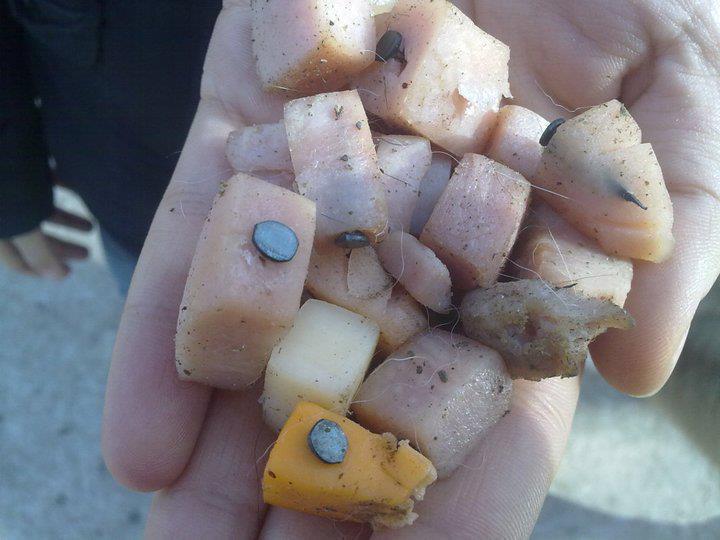
Bottom Line...no!  Bones are not good for your dog. Dogs may ingest splinters from bones that can lodge in their mouths or around their teeth or worse yet bone chips can get caught in the intestines and cause an obstruction, internal bleeding and impaction. 

One bone can cost several hundred dollars up to thousands of dollars for surgery if your dog is the unlucky one.  Even when surgery is done your pet may die.  So why take the chance?

The best 'bones' on the market are the Nylabonesฎ.  Just make sure that you get the appropriate size for the size of your dog.  These bones are relatively indestructible and are often flavored.  Your dog will get hours, days, and years from one of these chew bones.

Nylabonesฎ are the only bones we allow our dogs to have.

Food Pets Die for:
Shocking Facts About Pet Food

by Ann Martin
http://www.organic-pet-digest.com/homemade-dog-food-recipes.html

The Importance of Puppy Socialization
From the very start, a puppy learns important lessons through his experience of the world around him. Even in the first few weeks as he snuggles with his dam, wrestles with his littermates, and is handled by his breeder each day, the personality traits and social skills that he will have all his life are beginning to form.

As the weeks go by, exposure to a variety of experiences is crucial to his becoming a well-rounded adult. Studies have shown that a puppy's experiences in the first three months of life strongly influence what kind of companion he will grow to be and how he will react to the world. Will he shy away from children? Will he be afraid of people in hats? Will he be aggressive toward other dogs? Or will he be easygoing and adaptable in a variety of situations?
READ MORE...

"The man who rears a dog must complete what the breeder began..." Max v. Stephanitz; Father of the German Shepherd Dog

Dealing Dogs Documentary
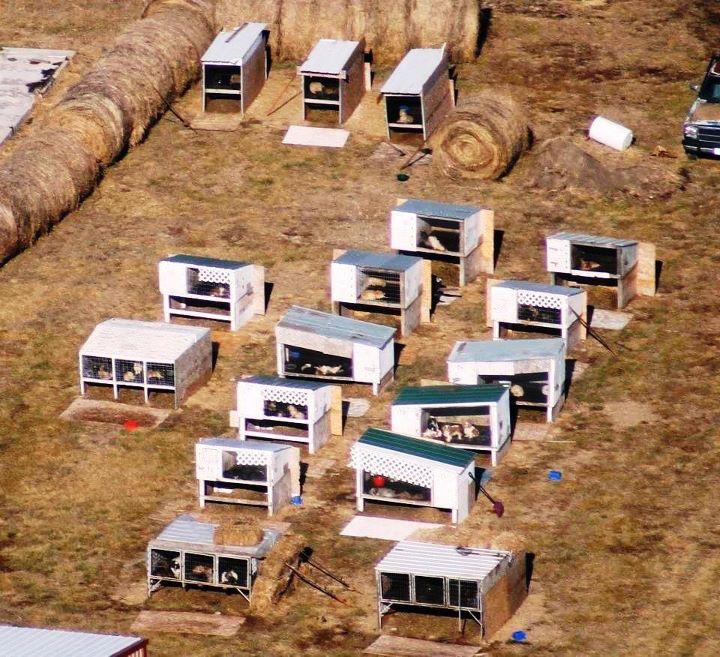
An animal rights outfit, Last Chance for Animals, outraged that 42,000 dogs are sold to vet schools and research labs by vile kennel keepers, sets out on one of the most notorious: Martin Creek Kennel in Arkansas. It sent in investigator "Pete" with a hidden camera for six months. He worked for the owners and collected his sickening images
and commentated on the atrocities as he went.  Many of the dogs that ended up at this kennel had been stolen from their
backyards and sold.
Not just from Arkansas but in areas around St. Louis Mo and all throughout the south.


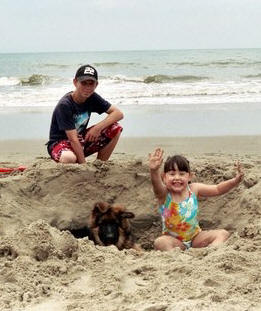
"Fun at the Beach"

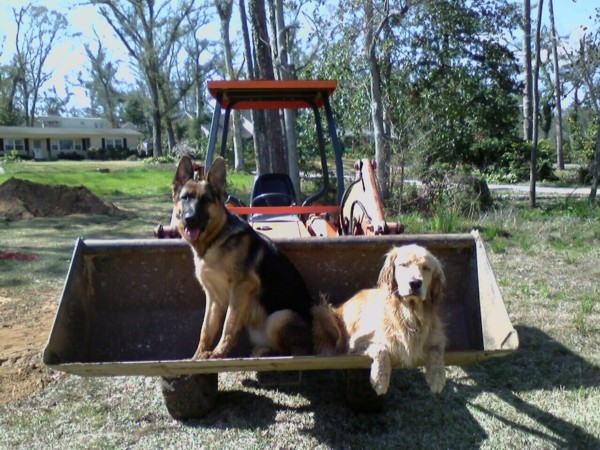
"Fun at Work"

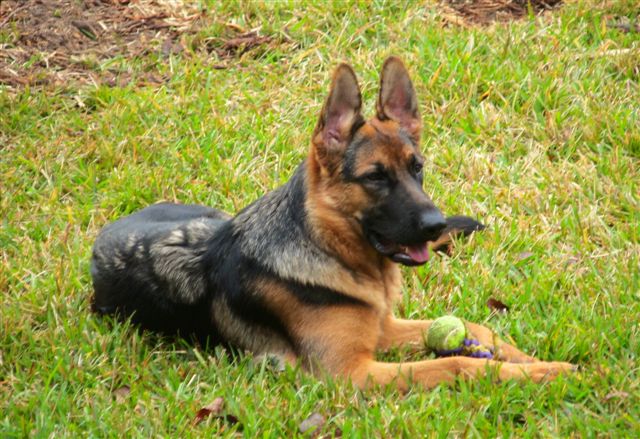
"Fun just hanging out"


How to Protect your Pet from Heat Stroke

How to encourage Your Dog to Drink if he is not Feeling Well.

Proper hydration is crucial in the healing process; however, the ill or painful dog may not be interested in drinking. It is important NOT to force water into your dog, as it could lead to aspiration pneumonia if your dog is not swallowing appropriately.  Listed below are several options to encourage your dog to intake water.

1. Give your dog an ice cube to lick.
2. Allow your dog to lick water from your hand or your finger.
3. Feed canned dog food, as it has a higher water content.
4. Add warm water or low-sodium broth to your dog's food.
5. With your veterinarian's permission, offer small amounts of Pedialyte.
6. Adding an ice cube to the water bowl can encourage some dogs to drink.

If your dog is weak and not interested in food or water, see your veterinarian.


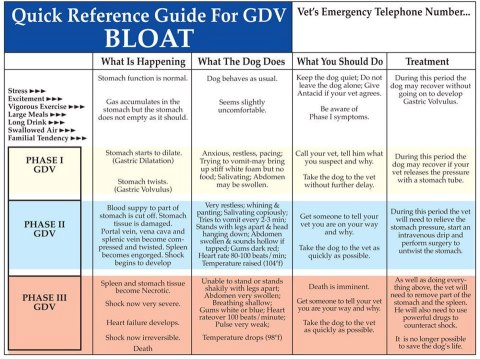
BLOAT


This is a real combination of symptoms that spells out EMERGENCY. These are the classic symptoms of a condition referred to as "bloat" - a dog that is pacing, restless and has unproductive attempts to vomit.

This is a common problem in large breed deep-chested dogs but can also occur in smaller dogs.

Basically what happens is this - the stomach twists causing the blood supply to the stomach to be compromised then leads to tissue death. As tissues are damaged, toxins are released and a sequence of events occurs that if left untreated, leads to death.

If you ever notice these symptoms in your dog, call your local veterinarian or emergency clinic as soon as possible.

This is a condition that is fairly common and often occurs in the evening or nighttime hours. It is also a very expensive condition to treat.  READ MORE...

 
            GOT FLEAS?
Place a white baking dish half full of water with a couple drops of Lemon Joy dishwashing liquid in the center of the room with a small lamp next to it.  Turn off all other lights and go to bed.  When you wake up in the morning all the fleas will be in the baking dish! For a bad infestation treat each room twice.
 

Dealing with Excessive Barking

The first step to stopping barking is to understand why it is happening. Dogs bark for all kinds of reasons, including anxiety, boredom and/or loneliness. Sometimes they bark just because it feels good.  Luckily, most dogs will respond to one or other intervention to curtail their barking. Whether you simply bring an outdoor dog inside or take the time to apply behavior-modification techniques, you can cause a dog to be less of a nuisance and to be more socially acceptable.


Removing Skunk Odor

No need for the tomato juice. Use a mixture of 10 parts hydrogen peroxide to 1 part baking soda. Add a dash of degreasing dishwashing soap and pour into a spray bottle. Spray liberally over dry coat and allow to air dry. Avoid eyes. Works on other objects, too!


FOR THOSE WHO LIKE BIRDING
 

Site designed and maintained by
Dlm Design Studio

Copyright ฉ 2001 [Haus Merkel]. All rights reserved.
Revised: 08/21/10.

Add Me! - Search Engine Optimization


Ruptured Anterior Cruciate Ligament (ACL)
Veterinary Services Department, Drs. Foster & Smith, Inc.


The knee is prone to a number of injuries as any football player will tell you. One of the most common knee injuries in dogs is a ruptured cruciate ligament.

Knee anatomy

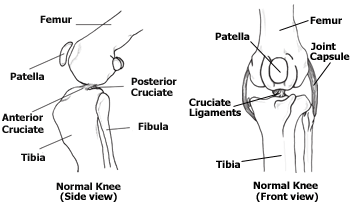
The knee is a joint that is formed by three bones: Femur (the long bone extending down from the hip); Tibia (the bone between the knee and ankle); and Patella (the kneecap). These bones are joined together by a number of ligaments, which are tough fibrous bands of tissue. Two ligaments crisscross in the joint from the femur to the tibia and are called cruciate ligaments (cruciate means cross). The one towards the front of the leg is called the anterior cruciate ligament and the one crossing behind it is the posterior cruciate ligament. These ligaments prevent the ends of the femur and tibia from moving back and forth across each other.

Normal Knee Anatomy
A rupture of the anterior cruciate ligament (ACL)


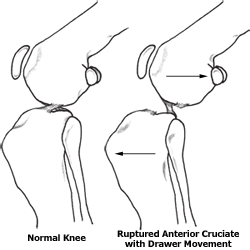
Ruptured Anterior Cruciate w/Drawer Movement
When the anterior cruciate ligament ruptures (is torn), the joint becomes unstable and the femur and tibia can move back and forth across each other. The anterior cruciate ligament is commonly torn when the dog twists on his hind leg. The twisting motion puts too much tension on the ligament and it tears. This often occurs if the dog slips on a slippery surface, makes a sudden turn while running, or is hit by a car. Obesity puts too much weight on the knee and overweight dogs tend to have more occurrences of ruptured cruciate ligaments. It appears that in most dogs with the problem, the ACL slowly degenerates and becomes weaker until it ruptures, without any sudden injury. Certain breeds appear to be at increased risk of ACL degeneration and include the Newfoundland, Labrador Retriever, Rottweiler, Bichon Frise, St. Bernard, and others. Many dogs with a degenerating ACL will have the condition in both knees. In small breed dogs, a luxating patella may predispose them to a ruptured anterior cruciate ligament.


Symptoms of a ruptured cruciate ligament

Dogs who have ruptured their cruciate ligament will appear suddenly lame, and usually hold the foot of the affected leg off the ground. The knee may become swollen. In time, the dog may start to use the leg again, but often lameness returns. Dogs with a degenerating ACL may also show some pain, and there may be some swelling in the joint.

Diagnosis of a ruptured cruciate ligament

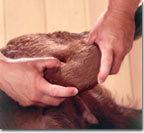
Veterinarian checking the knee of a dog for a The diagnosis of a ruptured cruciate ligament is made through observing abnormal movement of the joint. A veterinarian will place one hand around the femur and one around the tibia in a precise manner. By applying pressure on the knee, the veterinarian will feel the bones move abnormally in what is called a 'drawer sign.' It is called that because the movement of the femur in relation to the tibia is similar to pulling and pushing in the drawer of a cabinet. If an animal is in a lot of pain, or very nervous, the muscles near the knee may be so tense that they prevent the drawer movement from occurring. If a veterinarian suspects a ruptured cruciate ligament in a dog but cannot elicit the drawer sign, the dog may be heavily sedated to relax the muscles and then re-examined for the drawer sign. Many dogs with a ruptured cruciate ligament will have swelling on the inside aspect of the knee, and this is called a medial buttress. Radiographs are commonly performed to better assess the amount of arthritis that may be present.

Treatment of a ruptured cruciate ligament

If the ligament is completely torn, the dog (especially a large dog) is generally treated with surgery. There are several different methods used to repair the knee joint when an anterior ligament is torn. Some entail using synthetic suture material, or a portion of adjacent fibrous tissue to basically re-create the ligament. The suture or tissue is made to extend from the outside lower portion of the femur to the inside upper portion of the tibia. After the surgery, the dog must be strictly confined for 2 weeks. By day 10 after surgery, most dogs touch the toe of the affected leg to the ground and will start bearing minimal weight on the leg. Once the dog has reached this point, it is often very difficult to keep the dog quiet until complete healing has taken place. The dog generally has to be restricted to only leash walking for a minimum of 4-6 more weeks; the exact amount of time depends upon the extent of the injury and the corrective procedure performed. This is extremely important to prevent the surgical correction from tearing. The veterinarian's instructions regarding exercise during the recovery period should be followed very carefully.

Another surgery that may be performed is the tibial plateau leveling osteotomy (TPLO). In this procedure, a portion of the tibia is cut, moved, and reattached to a different portion of the tibia using plates and screws. By changing the conformation of the tibia, the joint is stabilized. This is a technically difficult surgery but it has shown to produce excellent results, often with less arthritis. This surgery is especially recommended for dogs over 50 pounds in weight. The recovery period is similar to that with the other surgical procedures.

The third procedure that may be used is the tibial tuberosity advancement (TTA). This is another surgery in which a different portion of the tibia is cut, and allowed to heal at a different angle to change the mechanical stresses on the joint. As with the TPLO, this surgery is more complex and it requires special equipment and training.

In some instances, if the cruciate ligament is only partially torn, the animal is older, has medical conditions which could affect healing, or the owners will not be able to keep the dog quiet for a number of weeks after surgery, medical treatment is used. This basically consists of controlling the dog's activity for 8-12 weeks. Swimming and low-impact exercise (walking) may be done on a controlled basis, as instructed by a veterinarian, to keep up muscle strength. If overweight, the dog should be placed on a reduced-calorie diet. Nonsteroidal anti-inflammatory drugs (NSAIDS) such as carprofen, etodolac, meloxicam, deracoxib, buffered aspirin, or other medications are often used to reduce inflammation in the joint and relieve pain. (Do NOT give your cat aspirin unless prescribed by your veterinarian.) Products containing glucosamine, chondroitin, perna mussel, polysulfated glycosaminoglycans, and other chondroprotective agents are often recommended, as well.

If a dog with a ruptured cruciate is not treated, severe degenerative joint disease (arthritis) usually occurs. In addition, because the dog favors the affected leg, he will generally put more weight on the unaffected leg. It is not unusual for the dog to rupture the anterior cruciate ligament on that leg as well because of the increased stress on the leg.

Prognosis

If the dog's exercise is restricted as instructed, and overweight dogs return to normal body weight, the prognosis is good. Depending on the amount of injury to the knee and length of time between the injury and correction of the problem, degenerative joint disease may occur as the pet ages


Last updated - Sunday, October 18, 2009 10:31:44 PM -0400

This site designed and maintained by Dyan Merkel of
DLM DESIGN STUDIO
Copyright ฉ2005

RESOURCES - SITEMAP